
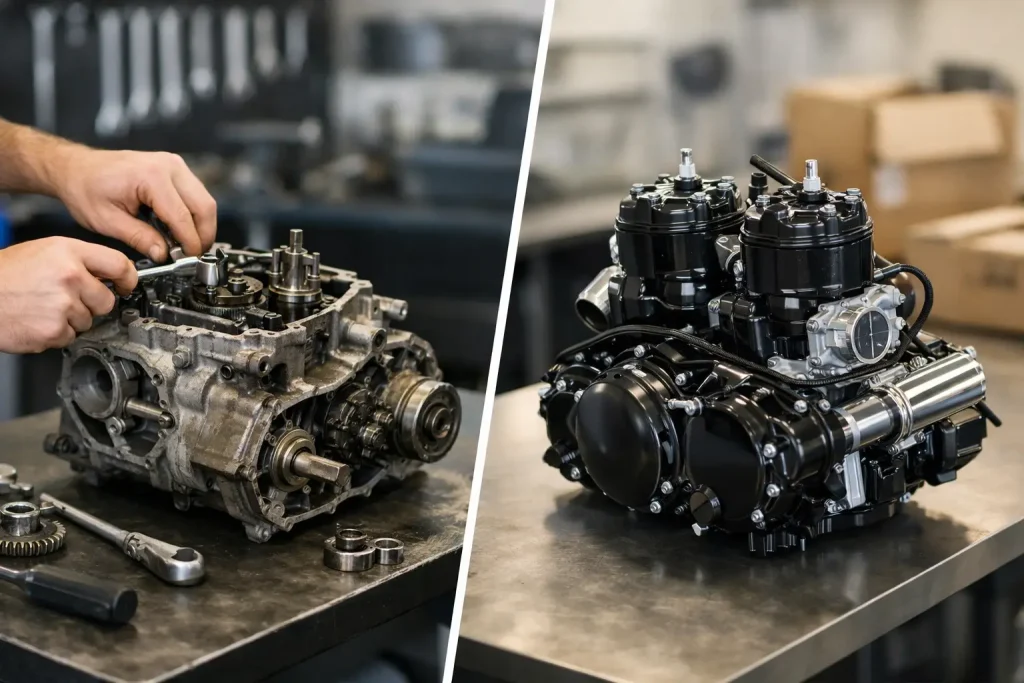
A Banshee engine usually tells on itself before it quits. Cold-start drama, rattling in the bottom end, a soft top-end hit, gear oil that looks wrong, or compression numbers that keep sliding – that is when the rebuild versus replace banshee engine question gets real. And for most owners, the right answer is not about one magic fix. It comes down to damage, budget, downtime, and what you want the quad to do when it goes back in the sand, woods, or track.
If you are chasing reliability on a clean rider, a rebuild often makes perfect sense. If your cases are damaged, your crank is questionable, and your cylinders need major work, replacement can save time and avoid stacking machine-shop costs on top of old problems. The trick is knowing which path actually gives you value instead of just moving money around.
Rebuild versus replace Banshee engine – what are you really deciding?
On a Yamaha Banshee, rebuilding means keeping your existing engine as the foundation and replacing worn or failed internal parts. That can be as simple as a top-end refresh with pistons, rings, and a bore or hone. It can also mean a full teardown with crankshaft, bearings, seals, transmission inspection, case work, cylinder repair, and fresh assembly from the bottom up.
Replacing means swapping in another complete engine or major assembly. That might be a stock replacement engine, a performance-built engine, or a used setup from another seller. It sounds faster, and sometimes it is, but replacement only works in your favor when the incoming engine is truly known-good or professionally built. A mystery motor can turn a quick fix into two engine jobs instead of one.
That is why this decision is less about rebuild versus replace as ideas and more about the condition of the engine in front of you versus the quality of the engine you could buy.
When rebuilding your Banshee engine is the smarter move
If your cases are solid, the transmission is healthy, and the crank has not destroyed the lower end, rebuilding is often the strongest value. You keep the original engine, you know the fitment, and you can address the exact wear points instead of gambling on someone else’s used parts. For owners who care about keeping a matching, known setup in their quad, that matters.
A rebuild also gives you control. You can stay stock for a dependable trail machine, or step up with port work, upgraded pistons, a performance crank, better reeds, or supporting mods that match your pipes and riding style. Instead of buying whatever spec another engine happens to be, you build around your goal.
There is also a trust factor. A properly rebuilt Banshee engine with quality parts, correct clearances, and the right break-in plan can be a much safer bet than a used engine with an unknown history. Plenty of engines get sold as fresh because they run. Running is not the same as being right.
Signs a rebuild probably makes sense
If compression is down but the engine has no major catastrophic damage, rebuilding is usually worth a hard look. The same goes for worn pistons, scored cylinders that are still repairable, leaking crank seals, noisy main bearings, or a top end that is simply tired from hours and heat cycles.
This is especially true if you already have a setup you like. Maybe the jetting is dialed, the pipes match the porting, and the quad runs the way you want when it is healthy. In that case, rebuilding preserves a package you already know.
When replacement is the better call
Sometimes the engine is too far gone for a sensible rebuild. Broken cases, major crank failure, windowed cylinders, damaged transmission components, or multiple layers of previous bad work can push the math in the wrong direction fast. Once machine work, hard parts, labor, and downtime stack up, replacement starts looking a lot more practical.
Replacement also makes sense when your priority is speed of turnaround. If you want to get back riding quickly and a proven complete engine is available, swapping can cut the wait compared with tear-down, inspection, machining, parts sourcing, and assembly.
For performance riders, replacement can be the cleanest path when your current engine is far below your target. If you want a fully built drag, dune, or aggressive play setup and your current motor is a worn stock core, stepping into a complete performance engine may be more efficient than upgrading piece by piece.
The catch with replacing a Banshee engine
Replacement is only as good as the engine you are installing. A used motor with unknown crank hours, weak compression, sloppy assembly, or hidden transmission issues can cost less up front and more later. That is the trap. Cheap replacement engines often look like a shortcut until you split the cases a month later.
A quality replacement engine should have clear build information, parts details, and confidence behind it. If that is missing, you are not replacing uncertainty. You are buying it.
Cost is not just the invoice
The rebuild versus replace banshee engine decision usually starts with price, but the real cost is bigger than the first number you hear. A rebuild can be affordable if the damage is limited. A simple top-end service is a very different job than a full engine restoration with cylinder repair and crank replacement.
On the other side, a replacement engine may seem straightforward until you add supporting needs like carb cleanup, intake parts, electrical troubleshooting, clutch components, or correcting issues from the old setup that were blamed on the engine. Installation is only one part of the story.
Downtime matters too. If the riding season is here and your quad is parked, time has value. But so does confidence. Saving a week only helps if the replacement engine is right.
Your engine goals should decide the direction
A stock or near-stock rider has different needs than a dune build or a hard-running weekend machine. If your goal is reliable starts, clean throttle response, and long service life, rebuilding your current engine to a known-good baseline can be the best route. You refresh what matters, correct wear, and get back to a setup that lasts.
If your goal is a noticeable jump in power, replacement can make more sense when the engine you are buying is already built around that target. A complete package with the right internals and supporting specs may be smarter than trying to convert a tired stock core into something it was never set up to be.
That said, performance is where people overspend fastest. Bigger does not always mean better if the rest of the quad is not ready for it. Clutching, fueling, cooling, gearing, and riding style all affect whether that replacement engine actually feels like an upgrade.
Questions that usually settle the issue
Before you commit, ask four things. First, what is actually damaged? Not what you suspect – what has been confirmed by inspection, leak-down, compression, and teardown if needed. Second, are your existing cases and major components worth saving? Third, what is the quality and history of the replacement engine available to you? Fourth, what do you want this Banshee to be six months from now?
Those answers usually point in one direction pretty quickly. Owners get stuck when they compare a best-case rebuild price against a best-case replacement price. Real decisions need real engine condition and real inventory, not wishful math.
Why expert diagnosis matters on a Banshee
Two-stroke problems can stack on each other. A tired top end might also be hiding a seal issue. A piston failure might have started with an air leak. A replacement engine might run fine but still be mismatched to your carbs, ignition, or pipes. That is why specialist inspection matters so much on a platform like the Banshee.
A shop that lives in this market can usually spot whether you are looking at a rebuildable core, a money pit, or a swap candidate worth pursuing. That saves cash and headaches. At Banshee Retailer, that is the advantage of dealing with a business built around one machine instead of treating your engine like just another ATV repair ticket.
The right answer depends on what you are starting with
If your current Banshee engine has a solid foundation, rebuilding is often the better long-term play because you keep control over quality, parts, and final setup. If the core is badly damaged or your goals have moved well beyond what that engine reasonably supports, replacement may be the cleaner path.
The best move is the one that gets you back on a Yamaha Banshee you can trust when the throttle is pinned. Start with an honest inspection, match the fix to your riding goals, and do not let a cheap shortcut decide the future of a legendary quad.