
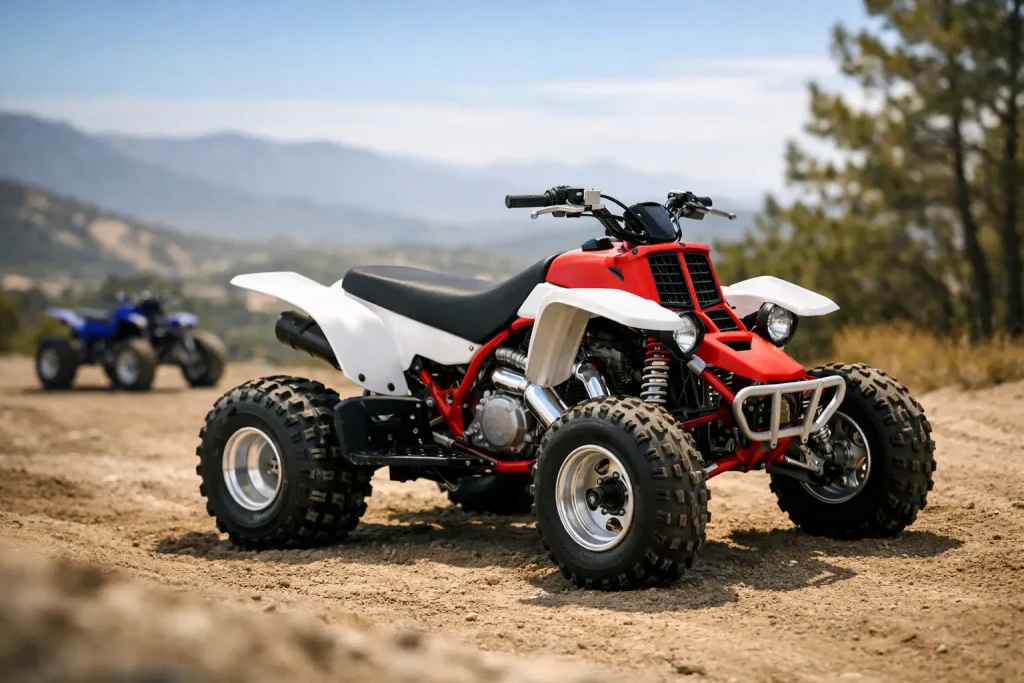
If you’re shopping for a quad, hunting for the right parts, or trying to verify what is sitting in your garage, the Yamaha Banshee production years matter more than most riders think. A clean ad might say “Banshee 350” and leave it at that, but year range affects value, fitment, emissions equipment, title paperwork, and how original the machine really is.
Yamaha Banshee production years at a glance
The Yamaha Banshee 350 was produced for the US market from 1987 through 2006. That is the answer most buyers are looking for, and it is the one that matters most when you are buying, restoring, or ordering parts in the United States.
That said, there is a little nuance. While US-market production ended after 2006, the Banshee continued in some international markets for a short period beyond that. If you come across an imported machine, a frame with mixed paperwork, or a seller claiming a later year, it is worth slowing down and checking the VIN, plastics, and market origin before assuming it matches standard US specs.
Why the production years still matter
With many older sport ATVs, people talk about model years like trivia. With the Banshee, the year can directly affect what you can bolt on, what you need to repair, and what the machine is worth.
For buyers, the year helps confirm whether a quad is represented honestly. For restorers, it helps separate a period-correct rebuild from a rider built from mixed parts. For performance owners, it helps narrow down electrical, intake, and chassis details that can change what fits cleanly and what turns into a garage headache.
The Banshee earned its reputation because it stayed true to the formula – lightweight sport chassis, twin-cylinder two-stroke power, and huge aftermarket support. But “mostly the same” does not mean “all years are identical.” Small differences add up fast when you are chasing originality or trying to order the right components the first time.
A quick history of the Yamaha Banshee production years
1987 to early 1990s
The Banshee landed in 1987 and immediately carved out its own lane. This was not a utility ATV trying to fake sport credentials. It was built for riders who wanted hard-hitting two-stroke power and a machine that felt alive every time the pipes came on.
Early models are especially interesting to collectors because they represent the start of the platform. If you are restoring one, originality carries more weight here. Buyers often pay attention to correct colors, factory-style components, and whether the machine still has period-correct parts instead of later swaps.
Mid-1990s to early 2000s
This is where a lot of surviving Banshees in the US market come from. By this point, the machine was already a legend, and owners were riding them hard, modifying them heavily, and building them for dunes, trails, and drag setups.
For many enthusiasts, these years strike a practical balance. You still get the classic Banshee platform, but availability can be better than the earliest years, and many owners are less concerned with concours originality than with clean frames, healthy engines, and quality upgrades.
2003 to 2006
The final US years are some of the most talked about because they represent the end of an era. Depending on condition and paperwork, later-year US Banshees can be very attractive to buyers who want a machine closer to the end of production without stepping into collector-only territory.
That does not automatically make them better for every rider. A heavily modified 1998 with a strong build and smart supporting mods may be a better buy than a tired 2006 that looks good in photos. Year matters, but condition and build quality still decide whether a Banshee is a winner or a money pit.
What changed over the years
The Banshee is famous for consistency, and that is one reason parts support remains so strong. Yamaha did not reinvent the machine every few seasons. That is good news for owners, but it can also create false confidence.
Some changes were cosmetic, including color schemes and graphics. Those details matter a lot if you are restoring a machine to factory appearance or trying to verify whether plastics and tanks are original to the frame year.
Other differences were tied to regulations and market-specific equipment. Depending on year and destination market, you may see variations in lighting, emissions-related components, and small equipment details. Those are the kinds of changes that can confuse buyers who assume every Banshee was built exactly the same from start to finish.
Electrical and fitment details can also matter more than people expect. Even when core chassis and engine architecture stayed familiar, owners working on wiring, intake systems, or replacement assemblies still need to confirm application by year. On a machine this old, previous owners often mix and match parts, so a year-based parts search is the starting point, not the final answer.
Are all Yamaha Banshee years equally desirable?
Not really. It depends on what you want.
If you are a collector, earlier examples with correct components can be especially appealing. If you are a rider who wants a dependable platform for trails, dunes, or performance upgrades, the best year is often the one with the straightest frame, strongest engine, and most honest maintenance history.
If you want a cleaner title path and a machine that feels newer on paper, later US production years can be attractive. If you care more about value per dollar, a mid-production machine with quality aftermarket support may make more sense.
This is where experienced Banshee buyers separate themselves from casual shoppers. They do not just ask, “What year is it?” They ask whether the frame, cases, harness, suspension, and modifications make sense together. A Banshee built from good parts can be excellent. A Banshee built from random leftovers can become expensive fast.
How to identify the correct year before you buy
Start with the VIN
The VIN is your first checkpoint, not the seller’s memory. On an older ATV, plastics get swapped, decals get replaced, and front ends get changed. The VIN gives you the strongest path to confirming the actual frame year.
If the machine has paperwork, make sure the title, frame, and seller description all line up. Any mismatch deserves attention. Sometimes there is a simple explanation, but sometimes it means the quad has a more complicated history than the ad suggests.
Look at the whole machine, not just one part
A lot of Banshees have lived multiple lives. You may see one with later plastics, earlier cases, aftermarket suspension, and a replacement harness. That is not always bad. In fact, many excellent rider builds are mixed-year machines assembled with purpose.
The issue is transparency. If you are paying premium money for an “all original” quad, mixed parts should lower the value. If you are buying a built rider, the focus shifts toward quality, compatibility, and who did the work.
Confirm parts fitment carefully
When you own an older Banshee, ordering by year is necessary but not always enough. Previous owners may have swapped carburetors, intakes, stators, axle carriers, or entire front ends. That is why serious Banshee support matters. Shops that actually know the platform can help you sort out what is stock, what is modified, and what fits your setup.
The biggest mistake buyers make with production years
The biggest mistake is assuming the newest year is automatically the best buy. That is true in some vehicle categories, but the Banshee market does not work that way.
A late-production machine with poor compression, cheap engine work, and mystery wiring is not a better purchase than an earlier quad with documented service, quality parts, and a straight chassis. The same goes for “rare” claims. Some sellers lean hard on year-based hype when the machine itself does not justify the price.
Smart buyers use the Yamaha Banshee production years as a filter, not a final decision. Narrow the market by year, then judge the quad by condition, authenticity, and whether the build matches your goals.
What the production years mean for parts and service
Because the Banshee ran so long with a familiar core design, support is still strong if you know where to look. That is one reason the platform refuses to fade away. Owners can still restore, repair, and seriously upgrade these machines instead of parking them when one component fails.
Still, age creates its own issues. Rubber hardens, wiring gets hacked, crank seals age out, and previous repairs are not always done right. On a platform this popular, there are excellent aftermarket parts and there are parts that create more problems than they solve.
That is why working with a Banshee-focused source matters. At Banshee Retailer, we see the same pattern constantly – riders lose time and money when they treat a Banshee like a generic old ATV instead of the specialized performance machine it is.
The Banshee lasted in the US from 1987 to 2006, but its appeal did not stop when production ended. If anything, those years made it one of the most recognized sport quads ever built. Know the year, verify the machine, and buy with a clear plan. That is how you end up with a Banshee worth riding, building, and keeping.