
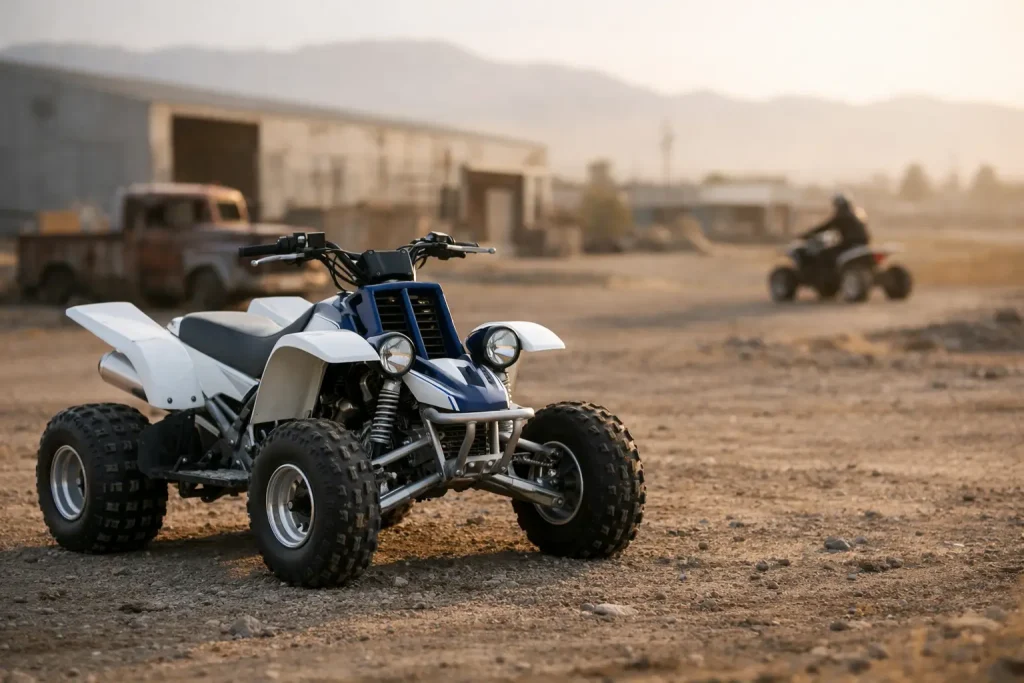
Ask almost any sport quad rider why the Banshee still has a cult following, and you will get the same answer fast – nothing else really felt like it. That is exactly why “why was the Yamaha Banshee discontinued” keeps coming up years after production ended. Riders did not stop caring when Yamaha stopped building it, because the Banshee was never just another ATV. It was a raw, twin-cylinder two-stroke machine with a powerband people still chase.
The short answer is this: the Yamaha Banshee was discontinued mainly because tightening emissions regulations made its two-stroke engine hard to keep legal and commercially viable. That is the big reason. But if you want the real answer, you have to look at the mix of emissions pressure, changing market demand, liability concerns, and the cost of redesigning an icon that was built around a very specific kind of performance.
Why was the Yamaha Banshee discontinued in the first place?
The biggest issue was emissions compliance. The Banshee used a high-performance 350cc twin two-stroke engine, and two-strokes are famous for power, quick revs, and simplicity. They are also famous for burning fuel and oil in a way that creates more exhaust emissions than comparable four-stroke engines.
By the 2000s, emissions standards were getting tighter in the United States and other markets. That put Yamaha in a difficult spot. The Banshee was still loved by enthusiasts, but keeping a carbureted performance two-stroke legal was becoming a serious engineering challenge. You can make a two-stroke cleaner, but doing it without changing its character, cost, and reliability is where things get complicated.
For a machine like the Banshee, the engine was the identity. If Yamaha had heavily redesigned it to meet stricter regulations, it might not have delivered the same hit, sound, and personality that made riders want a Banshee in the first place. At that point, Yamaha was not just updating an ATV. It was risking the core reason the machine had a loyal following.
Emissions rules changed the sport quad landscape
If you were around that era, you saw it happening across the powersports world. The industry was moving toward four-stroke platforms because they were easier to certify, easier to market as cleaner, and easier to fit into the direction regulators were pushing manufacturers.
That does not mean every four-stroke was better for every rider. It means the business case changed. Yamaha had to look at whether it made sense to continue producing a specialty two-stroke sport ATV when the regulatory burden was only going one way.
A lot of riders ask whether the Banshee was discontinued because it was dangerous. That is too simple. Performance machines always carry risk, but risk alone did not kill the Banshee. The real issue was that a high-output two-stroke, sold as a mass-produced recreational vehicle, became harder to justify in a market that was shifting toward stricter standards and broader appeal.
The two-stroke problem was not just about smoke
People sometimes reduce this to “two-strokes smoke, so they got banned.” That misses the full picture. The real challenge was unburned hydrocarbons and overall emissions output. Traditional two-stroke designs allow part of the fresh charge to escape during scavenging, which is one reason they are harder to clean up than four-strokes.
The Banshee’s engine design was brilliant for performance and tunability, but that same design made it tough to modernize under newer rules without major changes. Direct injection and other technology could help in theory, but now you are talking about a major redevelopment project for a niche sport ATV.
Yamaha also had to look at the business side
Enthusiasts often think in terms of horsepower, handling, and cool factor. Manufacturers have to think about certification costs, product liability, production efficiency, and where the market is headed next.
The Banshee had a devoted audience, but it was still a specialized machine. It appealed strongly to performance riders, dune riders, drag racers, and people who appreciated two-stroke power. That is a passionate market, but not always a massive one compared to utility ATVs and newer four-stroke sport machines that could be sold to a wider customer base.
From Yamaha’s side, investing heavily to re-engineer the Banshee for emissions compliance may not have made financial sense. It would have required serious development money, and there was no guarantee the updated machine would sell in enough volume to justify it. When a model is iconic, expectations get even tougher. Riders do not want “almost a Banshee.” They want a real Banshee.
Why was the Yamaha Banshee discontinued if people still wanted it?
Because demand alone is not enough if the machine no longer fits the regulatory and business environment. That is the part many fans hate, but it is true.
There were still plenty of buyers who wanted one. In fact, the Banshee’s aftermarket and used market prove that the platform never lost its pull. But manufacturers do not build vehicles based only on enthusiast love. They build them when they can sell them legally, profitably, and at scale.
That is why the Banshee became something even more interesting after production ended: a legacy platform with lasting value. Instead of fading away, it turned into one of the strongest enthusiast-driven ATV markets in powersports. Clean original units became more desirable. Good OEM parts became more valuable. Performance upgrades, engine work, suspension service, and restoration support all became more important.
Could Yamaha have saved it with a four-stroke replacement?
This is where it depends on what you mean by “saved.” Yamaha and the broader market did move toward four-stroke performance models, but a four-stroke replacement would not have been a Banshee. It might have filled a lineup slot, but it would not have replaced the experience.
The Banshee’s appeal was never just the badge. It was the twin-cylinder two-stroke hit, the aggressive feel, the sound, and the way the platform responded to pipes, porting, jetting, and engine builds. Riders who love Banshees usually know that no four-stroke truly scratches the same itch.
That is also why the discontinued status helped create the legend. Once production stopped, the market started separating average machines from great ones. Stock survivors mattered more. Properly built motors mattered more. Trusted parts sources mattered more. Experienced Banshee-specific service mattered more.
The aftermarket kept the Banshee alive
One reason this question still matters is that the Banshee never really disappeared from the riding scene. It just shifted from a current production machine to a specialist platform.
That shift changed how owners buy, maintain, and build them. When a model is discontinued, support becomes everything. You need the right parts, the right fitment knowledge, and technicians who understand the platform instead of treating it like a generic old ATV. That is where the Banshee world separated itself from the average used powersports market.
A strong aftermarket gave owners options that many discontinued machines never get. You can still find OEM-style replacement components, performance exhaust, engine packages, chassis parts, intake upgrades, suspension solutions, and restoration-grade pieces. More importantly, you can still improve a Banshee instead of just keeping it alive.
That matters because the Banshee is not a machine people usually leave alone. Some owners want a clean stock rider. Others want a dune build, drag setup, or aggressive trail machine. The platform has survived because it rewards both restoration and performance work.
What discontinuation means for buyers today
If you are shopping for one now, the fact that it was discontinued should not scare you off. It should make you more selective.
A discontinued Banshee can be a great buy, but condition and support matter more than ever. A clean machine with the right parts and a solid service history is a very different purchase than a beat-up quad with mismatched components and unknown engine work. The same goes for restorations and upgrades. Done right, they add confidence and value. Done wrong, they turn an iconic ATV into a headache.
That is why serious buyers usually look beyond the sticker price. They want to know what is in the motor, what aftermarket parts were used, whether the jetting and setup make sense, and whether replacement parts and service are still realistic long term. In the Banshee market, expertise is not a bonus. It is part of the product.
For that reason, businesses like Banshee Retailer exist in a lane of their own. When a machine is this specialized and this loved, owners want more than generic powersports inventory. They want people who know the platform, know what fits, and know what actually works.
The real reason the legend never died
So why was the Yamaha Banshee discontinued? Mostly because emissions rules and market realities caught up with a machine built around old-school two-stroke performance. Not because riders stopped wanting it. Not because the platform lost its value. And not because another ATV truly replaced what it did.
If anything, discontinuation locked the Banshee into a different kind of status. It stopped being just a production sport quad and became a permanent enthusiast machine – collectible, buildable, and still brutally fun when set up right.
That is the good news for current owners and future buyers. The factory may have stopped building Banshees, but the market around them is still very much alive, and the best ones are still earning their reputation every time they hit the sand, the trail, or the shop stand.