
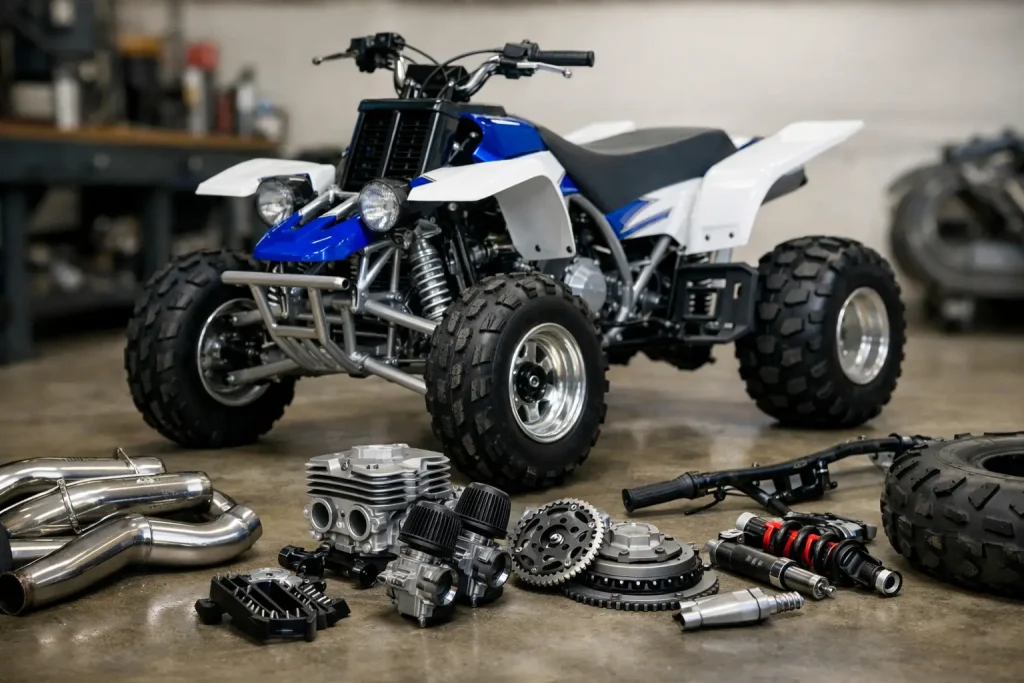
You usually find out fast whether you bought the right part for a Banshee. The bolt holes are off, the intake won’t seal, the axle spacing looks wrong, or the seller swore it “should fit.” If you’re asking what parts fit a Banshee, the real answer is not just a parts list. It’s knowing which components interchange across years, which upgrades are built specifically for the Yamaha Banshee, and where fitment starts getting expensive.
The Yamaha Banshee stayed remarkably consistent through its production run, and that is one reason the platform still has such a loyal following. A lot of core parts interchange between years, which makes maintenance, restoration, and performance builds much more realistic than they are on many older sport quads. But “a lot” does not mean “everything,” and that is where owners get tripped up.
What parts fit a Banshee across most years?
For most riders, the good news is simple. Many Yamaha Banshee parts fit across a wide range of model years with little or no modification. The chassis layout, engine platform, and major mounting points stayed close enough that a huge percentage of OEM-style replacement parts and aftermarket upgrades were designed around broad year compatibility.
That usually includes a large share of engine components, top-end parts, clutch components, many suspension items, intake parts, exhaust systems built for the stock chassis, plastics within matching generations, and common service parts like seals, bearings, and gaskets. If you are replacing worn parts with Banshee-specific components, your odds of good fitment are generally strong.
Where things get easier is when you stay within parts made specifically for the Yamaha Banshee rather than trying to cross-match from unrelated ATVs. The Banshee is its own animal – twin-cylinder two-stroke, unique frame geometry, and a performance aftermarket built around that exact platform. That is why purpose-built Banshee parts tend to save money in the long run.
The big difference between direct fit and possible fit
This is where fitment conversations go sideways. Some parts directly fit a Banshee because they were made for it. Other parts can be adapted, modified, or swapped with extra hardware, trimming, welding, or tuning. Those are not the same thing.
A direct-fit part should line up, mount correctly, and work as intended without fabrication. That is what most owners want, especially for engine internals, suspension, brake components, electrical parts, and chassis hardware. A possible-fit part may work in a custom build, but it introduces variables. Maybe the geometry changes. Maybe the carb tuning no longer matches. Maybe the chain line is off just enough to wear parts early.
If your goal is a clean repair or a reliable trail, dune, or drag setup, direct fit matters more than internet guesswork.
Engine parts that fit a Banshee
The engine is where the Banshee community has the most support, and that is a huge advantage. Pistons, rings, gaskets, crankshafts, clutch kits, transmission components, reed cages, intakes, carburetor kits, stators, and complete top-end or bottom-end rebuild parts are widely available for this platform.
But engine fitment still depends on your exact setup. A stock-cylinder Banshee and a ported big-bore drag build do not use the same assumptions. Cylinder size, porting, domes, carb size, exhaust design, and ignition tuning all affect what “fits” in a practical sense. A set of carbs may physically bolt on, for example, but if they are mismatched to your cylinders and pipes, the machine will never run right.
That is why serious Banshee owners do not just ask whether a part bolts up. They ask whether it matches the rest of the build.
Top-end and bottom-end fitment
Stock replacement top-end parts are usually straightforward as long as you confirm bore size and cylinder condition. Bottom-end parts require more care because crank quality, seals, cases, and transmission tolerances make a major difference in durability. On a twin two-stroke, cutting corners in the lower end is a fast way to turn a simple rebuild into a full engine failure.
The right fit here means more than compatibility on paper. It means parts that work together under real rpm and load.
Exhaust, intake, and carburetor fitment
Exhaust is one of the most common upgrade paths on a Banshee, and most riders know pipes can completely change how the quad runs. Plenty of aftermarket exhaust systems fit the Banshee chassis, but not all pipes are built for the same riding style. Some are tuned for low and mid power, some favor top-end pull, and some are built for aggressive drag or dune applications.
The same applies to intake and carburetor changes. A set of performance carbs may fit the engine, but clearance with the frame, airbox, boots, and filters matters. Intake boots, manifolds, reeds, and carb bodies need to match each other. If one piece is wrong, the whole setup becomes a headache.
This is one of the most common places people waste money. They buy individual parts because each one sounds right on its own, but the package does not work together.
Chassis and suspension parts that fit a Banshee
The Banshee aftermarket is strong in suspension and chassis upgrades, especially for owners who want better handling, more travel, or a more aggressive stance. A-arms, shocks, swingarms, axles, steering stems, tie rods, and lowering components are all common categories.
Still, fitment depends on how close you want to stay to stock geometry. A direct replacement axle is one thing. A wider aftermarket axle combined with extended a-arms and different front shocks changes more than width. It affects steering feel, stability, ride height, and wheel fitment. That can be excellent when the package is built correctly, but random combinations can create handling problems.
Used parts need extra caution here. A used swingarm or a-arms may technically fit a Banshee, but bent tabs, worn carrier areas, cracked welds, and old bearing bores can turn a bargain into a rebuild project.
Electrical parts and controls
Electrical fitment on a Banshee is another area where buyers should slow down. Stators, CDI boxes, coils, harnesses, regulators, switches, and lighting parts are not the place for guesswork. Year range, connector style, aftermarket ignition choices, and previous owner wiring changes all affect compatibility.
A Banshee that has already been modified may not match stock electrical assumptions anymore. If the machine has aftermarket lighting, a kill switch change, an upgraded stator, or a different ignition system, even a part listed as compatible can create extra work.
Controls are easier but still worth checking. Throttles, levers, cables, and perch assemblies often fit when designed for the Banshee, but cable routing and carb setup still need to be matched correctly.
Plastics, seats, and body parts
Body fitment is where many buyers assume all years are identical. They are close, but you should still verify details before ordering plastics, tank covers, seats, front noses, or mounting hardware. Aftermarket plastic kits can vary in finish, thickness, and exact hole alignment. Some need minor trimming or patience during install.
That does not always mean the product is wrong. It just means body components are more sensitive to frame tweaks, aftermarket subframes, and age-related damage than people expect. On a 20-plus-year-old ATV, even OEM mounting points may not be perfectly straight anymore.
If you are restoring a clean machine, exact fit and finish matter. If you are building a dune or race setup, function may matter more than perfect cosmetic alignment.
What parts from other ATVs fit a Banshee?
This is the question behind a lot of marketplace searches, and the safest answer is this: very few parts from other ATVs should be assumed to fit a Banshee unless the part is specifically known and documented as an interchange.
Some owners mix and match wheels, controls, or custom components from other Yamaha models or sport quads, but that does not make cross-platform swapping a standard fitment strategy. The Banshee has too many platform-specific dimensions and performance demands for broad assumptions.
If someone says a part “came off another quad and should work,” treat that as a custom-fit situation until proven otherwise.
How to avoid buying the wrong Banshee parts
The smartest move is to verify three things before you buy anything: your exact year, your current setup, and whether the part is truly stock replacement or built for a modified application. That sounds basic, but it prevents most costly mistakes.
You also want to look at the whole machine, not just the failed part. If your Banshee has aftermarket carbs, pipes, suspension, electrical changes, or hybrid repairs from previous owners, fitment becomes a system question instead of a single-part question.
This is where specialist support matters. A seller who lives in the Yamaha Banshee market can spot the red flags fast, especially on engine, chassis, and mixed-build fitment questions. Banshee Retailer exists for exactly that reason – to give owners access to parts and service backed by actual platform knowledge instead of generic catalog guessing.
The Banshee rewards owners who build with intention. If you match parts to the year, the setup, and the way you actually ride, you end up with a machine that starts easier, pulls harder, and stays together longer. That is always a better result than forcing a part to fit just because it was cheap.