
A Yamaha Banshee usually gives you a warning before the top end goes from strong-running to problem child. If you are asking when should Banshee top end be rebuilt, the real answer is not just hours or piston life on paper. It is compression, riding style, maintenance habits, tuning quality, and whether your quad still pulls clean like a healthy two-stroke should.
The Banshee is not a machine that rewards guesswork. Stay ahead of the wear cycle and a top end rebuild is routine maintenance. Wait too long and you can turn a simple piston-and-ring job into scored cylinders, damaged heads, or a much more expensive bottom end issue.
When should Banshee top end be rebuilt based on use?
There is no single rebuild interval that fits every Banshee. A dune bike ridden hard at high rpm will need attention sooner than a trail bike that gets short bursts and careful warmups. A stock engine with conservative jetting will usually last longer than a ported, high-compression setup that lives near redline.
As a general rule, many riders start watching top end health closely somewhere around 50 to 100 hours of riding time. Aggressive riders and racers may freshen it up even sooner. Casual recreational riders sometimes stretch beyond that, but that only works if compression stays healthy, the tune is right, and the cylinders still look clean.
Mileage is less useful than hours on a Banshee, but if you do not track hours, performance changes become your next best indicator. A top end rebuild should be driven by condition, not just a number.
The biggest signs your Banshee top end is getting tired
The most obvious sign is compression loss. A Banshee with a worn top end often gets harder to start, especially when cold. It may feel lazy off the bottom, lose that crisp hit in the midrange, or stop pulling hard on top the way it used to.
You may also notice more piston slap noise, extra spooge, inconsistent idle, or a bike that suddenly needs more kicks to fire. None of those signs automatically confirm the top end is done, but together they paint a clear picture. If the engine feels soft and less responsive, it is time to test instead of guessing.
A compression test is one of the smartest first checks you can do. More important than chasing an exact magic number is consistency between both cylinders. If one side is noticeably lower than the other, or both sides are down from where they should be, the top end needs attention.
Spark plug readings can help too. If your plugs show signs of poor combustion, oiling issues, or uneven running between cylinders, that can point to wear or a tuning problem that is speeding up wear. Either way, the top end deserves a closer look.
Hard starting and weak throttle response
A fresh Banshee usually feels sharp. Throttle response is immediate, the engine cleans out quickly, and the quad wants to rev. When the top end wears down, that clean, snappy feel starts fading.
Riders often describe it as the bike feeling flat. It still runs, but it does not have the same urgency. If you have to work harder for the same acceleration, the pistons and rings may no longer be sealing the way they should.
Excessive noise or piston-related symptoms
A little two-stroke mechanical noise is normal. Loud slap, rattling from the top end area, or signs of piston skirt wear are different. Those sounds can mean clearances have opened up too much.
That is where waiting becomes risky. Once wear passes a safe point, the chance of a skirt failure or ring issue goes up, and that is how a manageable service turns into cylinder damage.
What shortens top end life on a Yamaha Banshee?
The fastest way to wear out a Banshee top end is heat and detonation. Lean jetting, air leaks, poor fuel quality, and repeated hard runs without proper cooldown all put stress on pistons and rings. The Banshee is a performance machine, but it still needs correct tuning if you want reliability.
Poor air filtration is another big one. Dirt ingestion will chew up rings and cylinder walls quickly. If you ride dunes, trails, or dry dusty tracks, filter maintenance is not optional. A clean air filter is cheap insurance compared to a replate or bore job.
Warmup habits matter too. Hammering a cold two-stroke is a classic way to shorten piston life. Let the engine come up to temp, especially on modified setups with tighter clearances. That extra patience pays off.
Finally, engine mods change the schedule. Porting, aftermarket heads, high-compression domes, drag-style gearing, and aggressive riding all increase stress. A built engine can make great power, but it usually wants more frequent inspection and service.
When should Banshee top end be rebuilt on a modified engine?
Sooner than a mild stock machine. That is the honest answer. A performance Banshee with port work, bigger carbs, race fuel tuning, or sustained high-rpm use should be treated like a machine on a shorter maintenance clock.
That does not mean modified engines are fragile. It means the margin for neglect is smaller. If you are running a serious setup, regular compression checks, plug checks, and periodic tear-down inspections should be part of ownership.
Many experienced riders rebuild proactively on built motors rather than waiting for power loss. That approach costs less in the long run because it helps prevent cylinder damage and catches wear before it becomes a failure.
What gets replaced in a Banshee top end rebuild?
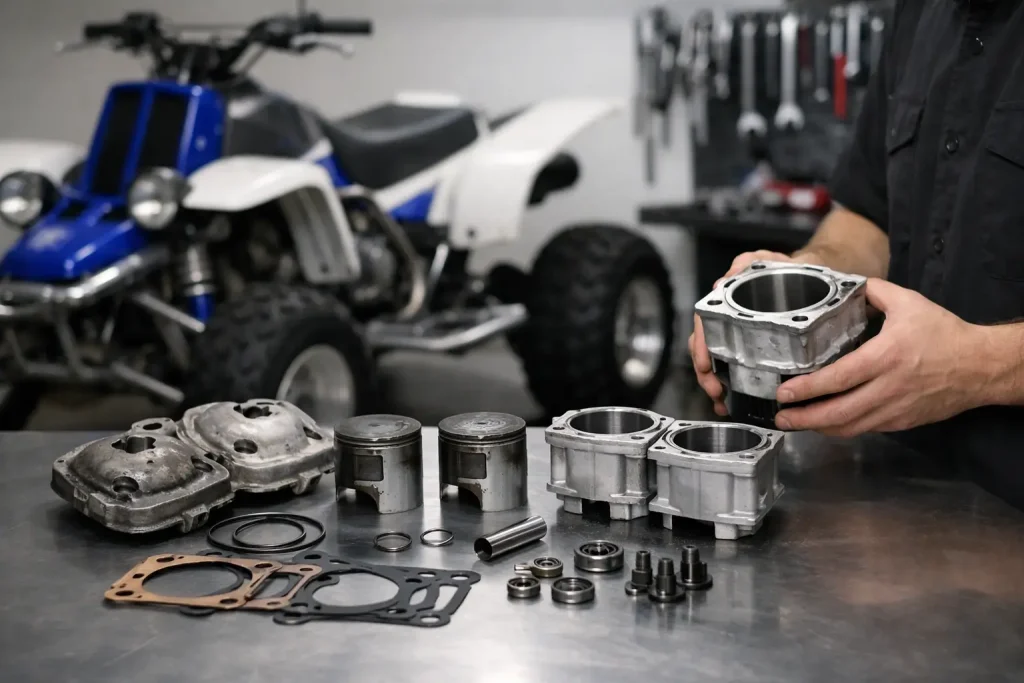
A proper top end rebuild usually means more than just tossing in new rings. Depending on condition, the job may include pistons, rings, wrist pins, circlips, gaskets, small end bearings, and a close inspection of cylinder bore condition, head surfaces, and cooling passages.
If the cylinders are worn, scored, or out of spec, they may need boring, honing, or replating depending on the setup. This is where Banshee-specific experience matters. You do not want to guess at piston-to-wall clearance on a two-stroke twin that depends on precision.
It is also smart to inspect reed condition, intake sealing, coolant system health, and any signs of crank seal issues while you are there. A fresh top end will not stay fresh long if an air leak or cooling problem is still in the system.
Rebuild early or wait for failure?
Early is almost always cheaper.
A planned rebuild gives you options. You can inspect parts carefully, keep the cylinders in better shape, and avoid the kind of debris damage that happens when a piston lets go. Waiting until the bike loses major power or starts making ugly noises usually means the repair bill grows.
There is a trade-off, of course. Rebuilding too early can mean replacing parts that still had life left. But with a Banshee, especially one that is ridden hard or modified, being a little early is usually smarter than being late.
If you bought a used Banshee and do not know the engine history, a top end inspection is often worth doing sooner rather than later. Previous owner claims are not maintenance records. Starting from a known baseline gives you confidence and protects the investment.
The smartest way to track top end health
If you want a real answer to when should Banshee top end be rebuilt, start tracking the machine like a serious owner. Log riding hours. Check compression periodically. Pay attention to starting behavior, throttle response, plug color, and any change in noise.
That pattern tells you more than internet guesses ever will. Two Banshees with the same piston brand and same estimated hours can be in completely different condition depending on jetting, filter care, fuel, and how hard they were ridden.
At Banshee Retailer, this is exactly why Banshee-specific service matters. A dedicated platform like this rewards owners who stay proactive and use parts, tuning, and rebuild work that match the engine combination instead of applying generic ATV logic.
Final thought
The best time to rebuild a Banshee top end is before the engine forces the decision for you. If compression is dropping, power is fading, or you do not know the service history, do not wait for a piston failure to confirm what the bike has already been telling you. A fresh top end keeps the Banshee fast, reliable, and ready to run the way it was meant to.