
Your Yamaha Banshee is a legendary powerhouse, but that raw twin-cylinder energy is useless if your tires spend more time bouncing off the dirt than gripping it. Most riders simply accept the bucking bronco behavior as part of the vintage experience. You’ve likely felt that gut-wrenching moment when the rear end kicks up on a high-speed washboard or the front end bottoms out hard after a modest jump. It’s frustrating when confusing terminology like rebound and compression keeps you from making the right adjustments. Mastering banshee suspension tuning is the single most effective way to transform your ride from a nervous, unpredictable handful into a precision-tuned performance machine.
We’re going to help you find that perfect balance of cornering stability and bottoming resistance. You will learn exactly how to dial in your settings for the dunes, understand the impact of modern geometry like +2 wide A-arms, and finally know when it’s time to invest in professional service rather than just turning a clicker. Whether you’re aiming for a plush trail ride or a high-speed desert setup, this guide provides the technical clarity you need to ride with total confidence. It’s time to stop fighting your machine and start leading the pack.
Key Takeaways
- Learn why the 350cc twin-stroke power delivery requires a specialized damping curve to eliminate the notorious rear-end bucking effect.
- Master the fundamentals of banshee suspension tuning by adjusting preload, compression, and rebound for a predictable and plush experience.
- Determine when to move beyond stock adjustments and opt for professional services to overcome the physical limits of factory valving.
- Fine-tune your machine for specific terrain, from maximizing floatation in the dunes to increasing ground clearance for technical woods.
- Understand how specialized mechanical labor ensures your suspension and high-performance components work together for peak reliability.
Why the Yamaha Banshee Needs Specialized Suspension Tuning
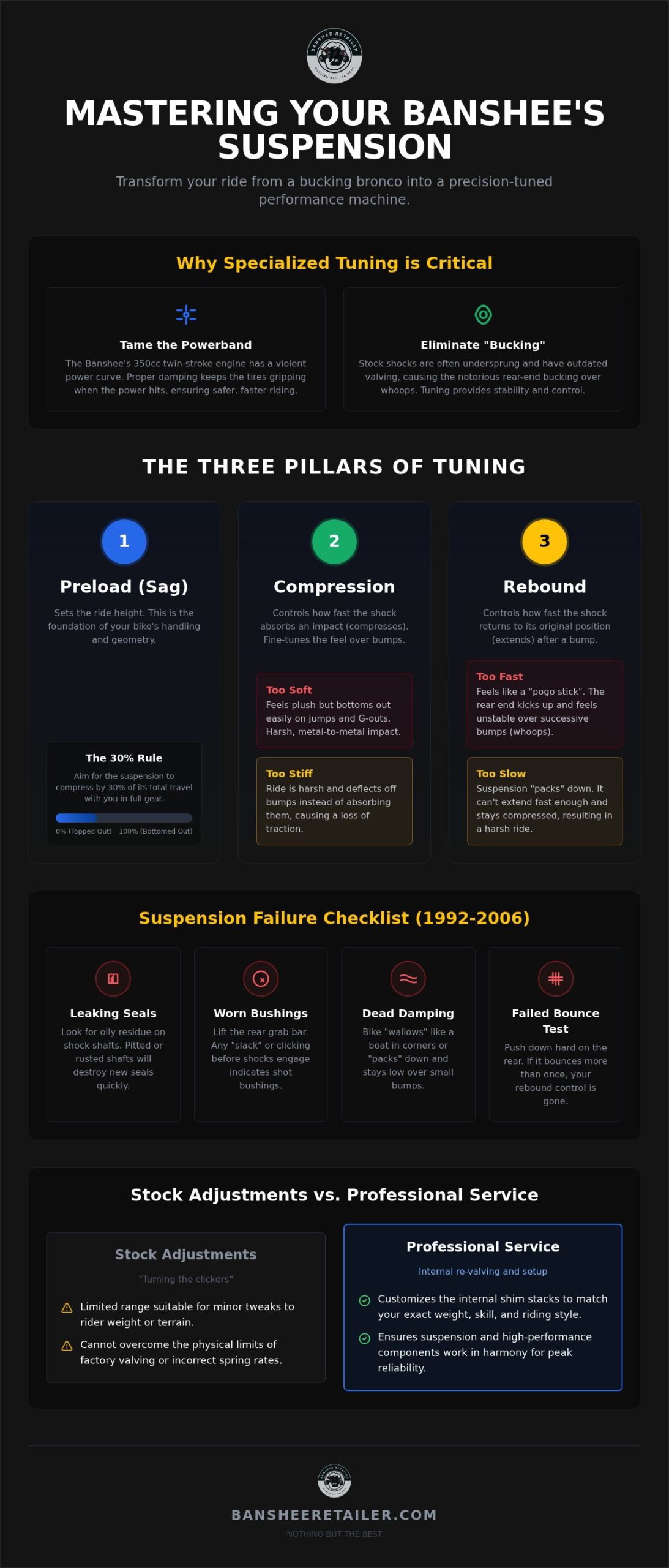
Most riders think more horsepower is the only way to go faster. They’re wrong. A 350cc twin-stroke engine produces a violent power curve that demands a specific damping profile. Unlike a modern 450, the Banshee hits the pipe with a surge that can easily unsettle a poorly set-up chassis. Professional banshee suspension tuning isn’t a luxury; it’s a requirement to keep those tires connected to the dirt when the power band kicks in. When your suspension is dialed, you aren’t just riding faster; you’re riding safer.
Have you ever hit a set of whoops and felt the rear end try to overtake the front? That’s the notorious “bucking” phenomenon. Stock shocks are often undersprung for adult riders or feature outdated valving that can’t react fast enough to high-speed impacts. This instability doesn’t just ruin your lap times; it puts massive stress on your frame and engine mounts. Proper tuning reduces harsh vibrations, which protects your engine cases and extends the life of your machine. There is a massive difference between “adjusting” a clicker and “tuning” the internal shim stacks for peak performance.
Anatomy of the Banshee Suspension System
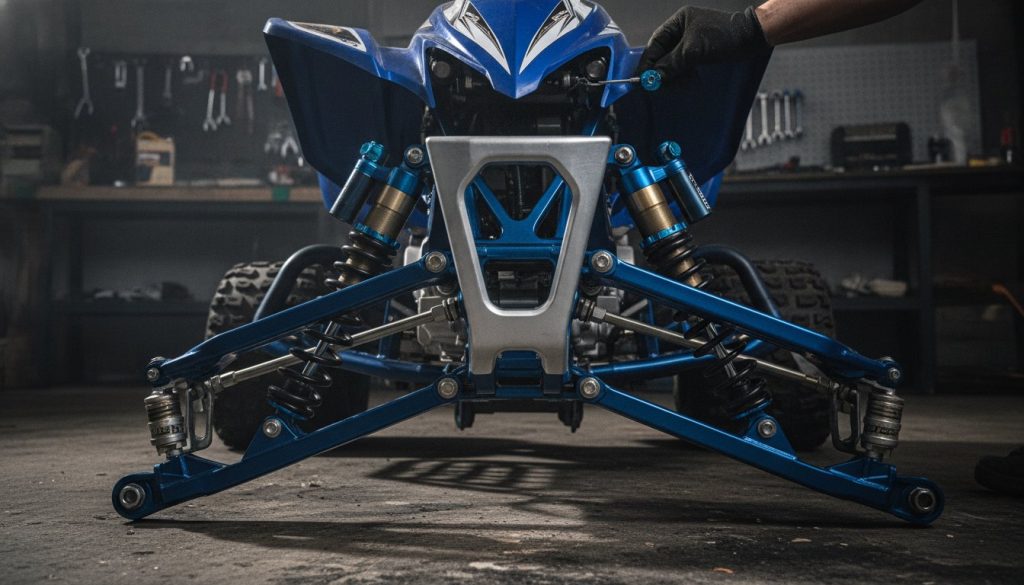
To master your ride, you need to understand the hardware under the plastics. The front A-arms dictate your cornering geometry and “camber gain” as the suspension compresses through a turn. Meanwhile, the rear swingarm and linkage act as the heart of your traction, converting engine torque into forward momentum. Reviewing the Yamaha Banshee 350 history shows that while the engine remained a legendary constant, the suspension hardware saw various updates over the years. You might be running early “pogo” style shocks or later models with remote reservoirs. Identifying your specific shock type is the first step toward a better setup.
Signs Your Suspension is Failing (The 1992-2006 Checklist)
If your Banshee has been sitting or seen hard seasons, your shocks are likely tired. Use this checklist to spot the red flags before a component failure ruins your weekend:
- Visual Cues: Look for oily residue on the shock shafts or leaking seals. Pitted or rusted shafts will tear through new seals instantly.
- Worn Bushings: Grab the rear grab bar and lift. If you feel “slack” or a clicking sensation before the shocks engage, your linkage or shock bushings are shot.
- Performance Red Flags: If the bike “wallows” like a boat in corners or “packs” down and stays low over small bumps, your internal damping is dead.
- The Bounce Test: Push down hard on the rear plastics and let go. The bike should return to its original height and stop. If it bounces more than once, there’s no rebound control left.
True banshee suspension tuning goes beyond just twisting a preload ring. It involves internal re-valving to match your weight and riding style, ensuring every bit of that twin-stroke power reaches the ground with precision. If you’re seeing any of these warning signs, review the complete Banshee suspension rebuild checklist to determine whether your shocks need a professional refresh before your next ride.
The Three Pillars of Tuning: Preload, Compression, and Rebound
Successful banshee suspension tuning isn’t about guesswork; it’s about mastering the three variables that dictate how your machine interacts with the ground. You can have all the engine power in the world, but if your suspension isn’t managed, you’re just spinning tires. To get that precision-tuned feel, you must understand how preload, compression, and rebound work together to create a cohesive ride. Understanding the basic principles of how motorcycle suspension works is vital before you start twisting dials, as it helps you visualize what’s happening inside the shock body during a stroke.
Setting Static and Rider Sag
Sag is the foundation of all handling geometry. It’s the amount your suspension compresses under the weight of the bike and the rider. For a Banshee, the 30% rule is your target. This means that with you in full gear, the suspension should sit at roughly 30% of its total travel. If it sits too high, you’ll lose traction and feel every pebble; too low, and you’ll bottom out on the smallest transitions. You’ll need a notched collar tool or a hammer and punch for the spanner rings to adjust the preload. Tightening these rings increases preload, which lifts the ride height and compensates for heavier riders or aggressive terrain.
Mastering the ‘Clickers’
Once your ride height is set, you can focus on the speed of the shock’s movement. Compression damping controls how fast the shock collapses when you hit an obstacle. If you’re casing jumps or feeling a harsh “clunk,” you need more compression. For small, high-frequency chatter like washboards, softening the compression allows the tires to track the terrain better. Rebound damping is equally critical; it manages the return stroke. Without enough rebound, the rear end will “kick back” violently after a jump face, leading to the bucking bronco effect we discussed earlier.
When you’re out testing, always start from “Full Hard” and work backwards. Turn your clickers all the way clockwise until they stop, then count your clicks out. This gives you a concrete baseline so you aren’t just turning knobs blindly in the dirt. If your factory components aren’t responding to these adjustments, it might be time for professional Banshee Suspension Services to refresh your internal valving and seals.
The final piece of the puzzle is the “Golden Ratio.” Your front and rear suspension must work in harmony. If the front is stiff and the rear is soft, the bike will “stinkbug” and dive into corners. A balanced Banshee stays level in the air and tracks straight through the whoops. When these three pillars are aligned, the machine feels like an extension of your body rather than a wild animal you’re trying to tame.
Stock Adjustments vs. Professional Suspension Services
Turning a clicker can only take you so far. While basic adjustments help, the internal components of a stock shock are often a massive compromise. Yamaha designed these units for an “average” rider, but most enthusiasts are anything but average. Professional banshee suspension tuning goes deep into the shock body, addressing the fixed valving and aging internals that a simple screwdriver can’t reach. If you’re still riding on factory oil from 1996, your damping isn’t just soft; it’s likely non-existent. A professional service restores that lost performance by replacing worn seals and degraded fluids with high-performance components.
One of the biggest advantages of professional labor is Nitrogen charging. Unlike atmospheric air, Nitrogen doesn’t expand significantly when it gets hot. This is critical for preventing shock fade during those long, high-energy dune sessions where your shocks are working overtime. For a comprehensive look at the basics before you dive into internal work, check out a guide to suspension setup to understand the external variables. When you move to professional services, you’re investing in consistency that lasts from your first lap to your last.
The Internal Magic: Re-valving Explained
Customizing your shim stacks is where the real transformation happens. Inside your shocks, a series of thin metal washers called shims control the flow of oil. By rearranging these stacks, a specialist can tailor the shock’s resistance to your specific weight and terrain. This isn’t just a repair; it’s a precision calibration. Fresh shock oil and high-quality seal kits are essential for vintage models, especially the 1996 editions that have survived decades of abuse. Re-valving eliminates the “one size fits all” feel of factory setups and provides a custom damping curve that stock units simply can’t match.
When to Upgrade to Aftermarket Shocks
Sometimes, rebuilding the stock units isn’t enough. If you’ve upgraded to a Duncan Racing Complete Engine, your power-to-weight ratio has likely outpaced the physical limits of the OEM hardware. This is when you look at aftermarket options like Elka or Roll Design Lobo II kits. These units offer larger oil reservoirs and more sophisticated adjustment ranges. Integrating high-end suspension with your high-performance engine ensures that every bit of torque is used for forward drive rather than wasted in chassis flex. If you’ve already identified the signs your Banshee suspension needs a professional rebuild, it’s the perfect moment to decide between a factory refresh or a total performance overhaul.
Terrain-Specific Setup: Dunes, Trails, and Drag
Setting up your Banshee for the sand is a completely different animal than prepping it for a technical woods race. While the fundamentals of banshee suspension tuning remain the same, your goals shift based on the dirt under your tires. To get the most out of your machine, you must adapt your clickers and ride height to the specific challenges of your favorite riding spot. A setup that works for a high-speed desert run will likely feel like a pogo stick in the tight, rocky woods.
Sand and Dune Performance
Dune riding is about high speeds and massive transitions. To stay planted in high-speed bowls, you want a lower center of gravity, but you must balance this with enough compression damping to survive “G-outs” at the bottom of a dune. If your bike feels like it’s wandering or hunting for a line, check your tire pressure. Dropping to 4-5 psi adds a layer of pneumatic suspension that helps with floatation, but it also changes how your shocks react to impacts. You need a setup that absorbs the big transitions without sacrificing the ability to skim over the top of wind-blown ripples.
Technical Trail and Woods Riding
In the woods, fatigue is your biggest enemy. You need a setup that’s plush enough to soak up roots and rocks without jarring your wrists or vibrating the bars. Softening the initial part of your travel is key here. You also want a faster rebound speed to keep the front end light, allowing you to pop over logs and obstacles with a quick blip of the throttle. Be careful with width; while +2 A-arms offer incredible stability in the open, they can be a liability in tight, technical sections where every inch of clearance counts. Woods riding demands a reactive, agile machine that doesn’t fight you in the tight stuff.
For those focused on the drag strip, the priority shifts to the launch. You want to minimize front-end lift to keep your weight over the front tires while allowing enough rear squat to help the tires bite. It’s a delicate balance that often requires specific rear valving to prevent the bike from blowing through its travel the moment you drop the clutch.
Don’t try to tune the entire trail at once. Use the “Section Method.” Find one specific jump, turn, or set of whoops and ride it repeatedly. Make one change at a time, note the difference, and move on only once that section feels perfect. If you’re struggling to find that sweet spot between comfort and control, our team provides expert Banshee Suspension Services to help you establish a terrain-specific baseline that works for your unique riding style.
Optimizing Your Banshee with Professional Support
Mastering your machine requires more than just a set of tools; it demands a deep understanding of how every component works in unison. While DIY adjustments are perfect for fine-tuning your weekend ride, elite performance often requires the steady hand of a specialist. At Banshee Retailer, our approach to banshee suspension tuning is rooted in decades of experience with the 1992 to 2006 models. We don’t just look at the shocks in isolation. We analyze how your power delivery, chassis stiffness, and suspension geometry interact to create a cohesive, high-speed experience. Professional installation ensures that your high-end Duncan Racing components and suspension valving are perfectly synchronized for the way you ride.
Maintaining your investment is just as critical as the initial setup. Tuned shocks are precision instruments that require a consistent seasonal maintenance schedule. Over time, heat and friction degrade shock oil and deplete nitrogen charges, leading to the “fade” that ruins long dune sessions. By staying ahead of wear with professional Banshee Suspension Services, you ensure that your machine remains a precision-tuned performance machine rather than reverting to a bucking bronco. It’s about reliability and the peace of mind that comes from knowing every bolt has been torqued to spec by a master of the craft.
Comprehensive Technical Support
A truly optimized build looks beyond the shocks. During a professional service, we inspect critical stress points like engine mounts and frame welds that often take a beating from years of hard landings. Protecting these tuned components is equally important. Sourcing an authentic 1996 Yamaha Banshee OEM Plastic Kit doesn’t just keep your bike looking factory fresh; it provides the necessary coverage to shield your linkage and reservoirs from abrasive sand and debris. Having a one-stop-shop for both Banshee Engine Repairs and specialized suspension labor means your entire build is handled with a singular focus on peak performance and mechanical integrity.
Next Steps for Your Build
If you’re ready to take your handling to the next level, start by preparing your hardware for a professional refresh. Clean your shocks thoroughly and inspect the mounting points for any signs of ovaling or cracks. If you’ve recently installed Tommey T6 Exhaust Pipes, your chassis balance might have shifted due to the weight savings and increased mid-range hit. Integrating these performance upgrades with a re-valved suspension ensures that your Banshee stays level and predictable under hard acceleration. Don’t let outdated factory settings hold back your twin-stroke power. Contact the experts at Banshee Retailer for your suspension service today!
Take Control of Your Ride
Transforming your Banshee from an unpredictable handful into a precision-tuned performance machine is the ultimate upgrade. You’ve learned that mastering preload, compression, and rebound is the key to unlocking the potential of that legendary 350cc twin-stroke power. Whether you’re skimming sand ripples in the dunes or navigating technical woods, the right setup ensures your tires stay glued to the dirt. Professional banshee suspension tuning bridges the gap between factory compromises and elite-level handling.
At Banshee Retailer, we provide specialized technical support for vintage Yamaha models with a focus on high-performance integration. As an authorized marketplace for Duncan Racing components and Tommey T6 exhaust pipes, our expert mechanical services prioritize your machine’s reliability and precision. Don’t settle for a harsh, wallowing ride when you can have a chassis that tracks straight and stays level through every jump.
Book Your Professional Banshee Suspension Service today and experience the difference that expert calibration makes on your next outing. Your machine has the heart of a champion; it’s time to give it the legs to match.
Frequently Asked Questions
Can I rebuild the stock front shocks on a Yamaha Banshee?
No, the factory front shocks on most Yamaha Banshee models are sealed, non-rebuildable units. If your front end feels bouncy or soft, it usually means the internal damping has failed. You should look into a set of aftermarket reservoirs or high-quality replacements to restore control. Upgrading these components is a critical part of banshee suspension tuning for anyone looking to push their machine beyond casual trail riding.
How often should I service my Banshee suspension?
You should service your suspension at least once per season or every 40 to 50 hours of aggressive riding. Sand and dirt are incredibly abrasive, and they eventually work their way past the seals over time. Regular maintenance involves changing the shock oil and checking the nitrogen charge to prevent damping fade. If you notice oily residue on the shafts or a loss of rebound control, it is time for professional service immediately.
What is the best suspension upgrade for a Banshee 350?
The best upgrade depends on your terrain, but a set of adjustable aftermarket shocks paired with +2 wider A-arms is the gold standard for performance. This combination increases stability and provides a much plusher ride through high-speed whoops. Integrating these upgrades with a Duncan Racing complete engine ensures your chassis can handle the increased power. High-quality components from brands like Elka offer the adjustment range needed for precision tuning and long-term reliability.
How do I stop my Banshee from bucking in the rear?
To stop the rear end from bucking, you need to increase your rebound damping to slow down the shock’s return stroke. This prevents the spring from kicking the back of the bike up after hitting a jump face or a large transition. You should also verify that your rider sag is set correctly at roughly 30% of total travel. If your factory shock is worn out, professional banshee suspension tuning or a complete internal rebuild may be necessary.
Does a wider A-arm kit require different shocks?
Yes, wider A-arm kits change the leverage ratio on your front end, which usually requires shocks with specific valving or longer travel. If you run stock shocks with a +2 wide kit, the front end will feel excessively soft and bottom out easily on modest impacts. Most enthusiasts opt for a complete front-end package that includes both the A-arms and compatible shocks to ensure the geometry remains correct for high-speed cornering stability.
What are the benefits of Nitrogen-charged shocks for sand riding?
Nitrogen-charged shocks provide consistent damping performance by preventing oil cavitation and resisting heat expansion during hard use. During long sessions in the dunes, your shocks work overtime and generate significant internal heat. Unlike regular air, nitrogen doesn’t expand as much when it gets hot, which prevents your suspension from becoming mushy or fading halfway through the day. This reliability is essential for maintaining control in deep sand and large transitions.
How do I set the sag on my Banshee if I ride with a passenger?
You must set the sag with both you and your passenger on the machine in full riding gear. This ensures the suspension sits at the correct ride height for the total combined weight. You will likely need to increase the preload on your rear spring to compensate for the extra load and prevent bottoming out. Keep in mind that the added weight significantly changes the handling, so you may also need to stiffen your compression settings.
Is it worth rebuilding shocks on a 1992 Yamaha Banshee?
Rebuilding the shocks on a 1992 Yamaha Banshee is absolutely worth it if the shock bodies and shafts are in good condition. A professional rebuild restores the factory damping performance and is often more cost-effective than buying entry-level aftermarket units. For a vintage restoration, keeping the original hardware while upgrading the internal valving provides an authentic feel with modern reliability. It is an excellent way to preserve a classic while drastically improving the ride.