
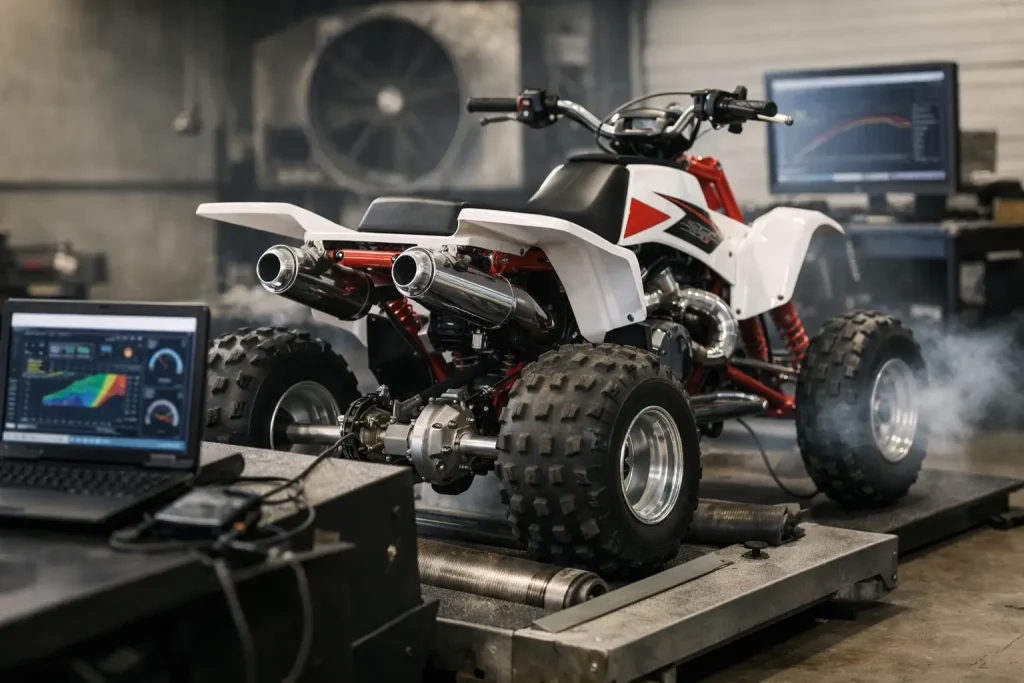
Ask three riders how much hp does tuning add, and you will probably get three different answers. That is because tuning is not one single mod. On a Yamaha Banshee, tuning can mean jetting carbs, cleaning up timing, dialing in compression, matching pipes to the setup, or refining a full engine build. The real answer depends on what the quad already has, how far off the current setup is, and whether you are chasing peak numbers or stronger power everywhere.
For a basically healthy Banshee with common bolt-ons, a proper tune can add a small but noticeable amount of horsepower – often in the 2 to 5 hp range at the wheels when the machine was already close, and sometimes more if it was badly out of tune. On a more serious setup with pipes, port work, bigger carbs, and supporting mods, tuning can be worth even more because the engine has more potential to expose. More importantly, the gain does not always show up as one big top-end number. A good tune can sharpen throttle response, clean up the midrange, and make the power feel harder and more usable in the dirt.
How much hp does tuning add in the real world?
If you want the straight answer, most riders should think in ranges, not promises. A stock or near-stock Banshee that is healthy but not perfectly dialed might only pick up a couple horsepower from jetting and setup corrections. That may not sound huge on paper, but on a two-stroke sport quad, a clean-running engine feels dramatically better than one that is rich, lazy, or uneven between cylinders.
If the machine already has pipes, filters, and other intake or exhaust changes, tuning becomes more valuable. Those parts can absolutely add power, but only if fuel, air, and timing are working together. In that situation, it is common for the tune to be the difference between a setup that looks fast in a parts list and one that actually pulls hard on the trail, in the dunes, or on a drag pass.
A poorly tuned Banshee can leave a surprising amount on the table. If the carbs are way rich, if the plugs are fouling, if the sync is off, or if one cylinder is not doing the same work as the other, the engine may feel flat even with good parts installed. Fixing that can produce gains that feel much bigger than the dyno sheet suggests.
Why the answer depends on your starting point
The biggest factor is not the tune itself. It is how far off the current setup is.
A fresh, well-built Banshee that was already tuned correctly may only see fine adjustments. In that case, the horsepower gain from another tuning session might be modest. You are polishing an engine that already runs where it should.
But if you bought a used machine with unknown jetting, random aftermarket parts, worn reeds, air leaks, or a mismatch between carbs and pipes, tuning can change the whole personality of the quad. Sometimes the best “horsepower mod” is correcting what someone else guessed at.
Altitude and weather matter too. A Banshee that runs decent in cool air at one elevation can get sloppy when conditions change. Two-strokes react quickly to density changes, and that is why a tune that was acceptable in one place may not be right in another. Riders who move between dunes, woods, and open desert know this better than anyone.
What tuning actually includes on a Yamaha Banshee
When riders ask how much hp does tuning add, they usually picture carb jetting first. That is a big part of it, but it is not the whole job.
On a Banshee, tuning often starts with carb setup – pilot jets, mains, needle position, air screw adjustment, float height, and synchronization between the two carbs. From there, you are looking at ignition timing, plug reading, compression health, reed condition, airbox or filter setup, and whether the exhaust and intake combination even makes sense together.
That is why tuning should not be treated like a magic screw-turning session. If the engine has worn top-end parts, leaking crank seals, weak reeds, or poor assembly choices, no amount of fine adjustment will deliver full power. A real tune works best on a mechanically sound platform.
Jetting is where many gains hide
Jetting is often the first place real power is found or lost. Too rich, and the engine blubbers, hesitates, and leaves power in the pipe. Too lean, and it may feel crisp for a moment while risking heat and damage. The sweet spot is where the engine pulls cleanly through the range, loads up less, and transitions hard into the powerband.
On a Banshee, proper jetting also protects the engine. Chasing horsepower without respecting fuel demands is how riders turn a strong weekend into a teardown.
Timing and supporting mods matter
Timing changes can affect how and where the engine makes power, but they are not a free-for-all. Advancing timing may improve low and mid response on some builds, while other combinations want something different depending on fuel, compression, and porting. The right answer depends on the whole package.
The same goes for reeds, pipes, carbs, and port work. Tuning gets better results when the parts are matched. Great pipes with a lazy carb setup will disappoint. Ported cylinders with the wrong carbs can feel strange. The best gains show up when the system is built as a package instead of a pile of parts.
Peak horsepower is only part of the story
A lot of riders fixate on the biggest dyno number. We get it. Horsepower sells parts, wins arguments, and looks great in a screenshot. But on a Banshee, usable power matters just as much.
A proper tune can widen the powerband, make the engine cleaner coming onto the pipe, and improve consistency under load. That matters when you are climbing, dragging, or trying to keep the quad responsive in tighter terrain. A machine that makes 3 extra hp but delivers it sharply and predictably is often more fun than one that posts a bigger number with ugly fueling.
That is why experienced Banshee owners usually talk about how the quad runs, not just what it makes. Crisp starts, strong pull, clean revs, and stable temps are all signs the tune is doing its job.
Common setups and realistic expectations
For a mostly stock Banshee, expect tuning to be more about cleaning up performance than transforming it. If the quad is healthy and close to correct, gains are often modest. If it is off, the improvement can feel dramatic.
For bolt-on setups with pipes, filter changes, and reeds, tuning is almost mandatory if you want the parts to earn their keep. This is where those 2 to 5 hp gains are pretty realistic, with occasional bigger improvements when the setup was poor to begin with.
For built engines with porting, larger carbs, higher compression, and race-oriented components, tuning becomes a bigger deal. The horsepower available from a proper setup is higher because the engine has more room to respond, but the margin for error gets tighter too. A serious Banshee build without serious tuning is leaving power on the bench.
The trade-off every rider should understand
More power is great. Reliability is better.
The smartest tune is not always the most aggressive one. Especially on a two-stroke, the edge of peak performance can sit close to the edge of damage. Leaning a setup out for one more number or pushing timing for a little extra snap may not be worth it if you ride hard, ride long, or want the engine to live.
That is why experienced shops tune for your actual use. A duner, a trail rider, and a drag racer do not need the same setup. Fuel quality matters. Elevation matters. Load matters. The best tune is the one that fits how you ride and keeps the machine strong over time.
When a tune is worth more than another part
There is a point where adding more hardware stops making sense until the current combination is sorted out. If your Banshee has decent components already but still feels soft, inconsistent, or dirty through the revs, tuning may be the smartest next move.
That is especially true with used quads. A lot of Banshees come with mystery parts, guessed-at jetting, and years of mixed decisions from previous owners. In those cases, proper tuning is not just about adding horsepower. It is about finally getting the machine to run like the parts say it should.
At Banshee Retailer, we see this constantly – riders spend money on performance parts, then discover the real gain comes from putting the full setup together correctly.
So, how much hp does tuning add? Usually enough to matter, rarely enough to be guessed without context, and sometimes far more than riders expect when the setup was off. If your Yamaha Banshee already has the right foundation, a proper tune can turn good parts into real performance – and that is where the fun starts.