
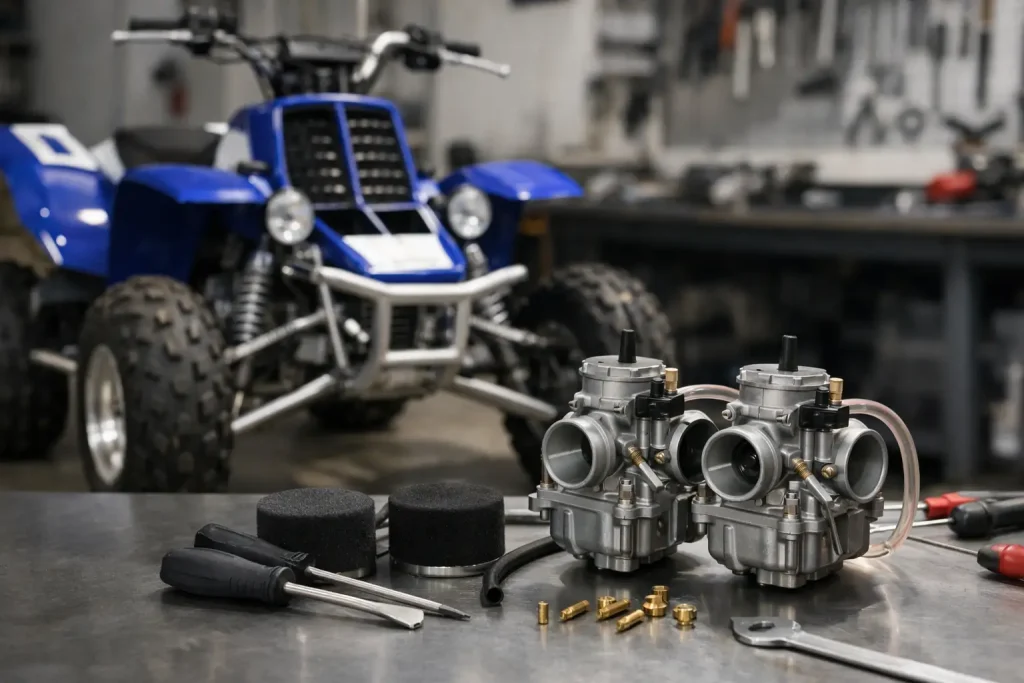
A Banshee with the wrong carb setup will tell on itself fast. It blubbers off idle, hangs on decel, loads up between shifts, or feels clean down low and scary lean on top. This yamaha banshee carb setup guide is built for riders who want a strong-running quad, not a guessing game that ends with fouled plugs or worse.
The Banshee rewards accurate tuning. Twin carbs, a two-stroke powerband, weather changes, and aftermarket mods all make carb setup matter more than it does on a lot of other machines. If your quad has pipes, filters, a cool head, port work, or larger carbs, getting the settings close is not enough. Close can still run hot, hesitate, or leave power on the table.
What the Yamaha Banshee carb setup guide should fix
A proper setup should give you predictable starting, a stable idle, crisp low-end response, a clean pull through the midrange, and top-end that feels strong without going flat. That sounds simple, but each carb circuit handles a different part of throttle position, and one bad setting can mask another.
The pilot circuit controls idle and the first crack of throttle. The needle and needle jet own most of the midrange where trail riders and dune riders spend a lot of time. The main jet comes into play as the throttle gets high and the engine is really moving air. Float height affects all of it because fuel level inside the bowl changes how each circuit behaves.
That is why random jet swaps usually waste time. If you change three things at once, you do not know what fixed the problem or what created a new one.
Start with the right baseline
Before touching jets, make sure the rest of the machine is worth tuning. A tired top end, leaking crank seal, air leak at the intake boots, dirty carbs, weak reeds, clogged petcock, or low compression can imitate carb problems. No jetting chart saves a motor with an air leak.
Start with fresh plugs, clean fuel, a clean air filter, and carbs that have been fully cleaned – not just sprayed from the outside. Confirm the choke works correctly, the slides move freely, and both carbs are synchronized so they open together. If one slide lifts sooner than the other, the quad will feel uneven no matter how close the jets are.
Also be honest about your setup. Stock cylinders with stock pipes need a different baseline than a ported motor with aggressive pipes and pods. Elevation and temperature matter too. A Banshee tuned on a cool morning at low elevation may be rich by afternoon, while the same machine taken into colder air can edge lean if you do not account for it.
Yamaha Banshee carb setup guide by circuit
The cleanest way to tune a Banshee is from low throttle to high throttle. Start with the pilot circuit, then the needle position, then the main jet. Float height and sync should already be set before serious testing.
Pilot jet and air screw
If the quad is hard to start, wants a lot of choke when warm, hangs at idle, or coughs when you crack the throttle, start here. Set idle speed first so the engine will stay running consistently. Then adjust the air screw in small steps and listen for the highest, cleanest idle response.
If the air screw ends up barely open, the pilot may be too small. If it needs to be turned way out to run right, the pilot may be too large. The exact sweet spot varies, but the logic stays the same – the air screw should end up in a workable range, not at one extreme.
A lean pilot usually shows up as hanging idle, surging, and a dry hesitation right off idle. A rich pilot tends to give a soggy burble, heavy smoke, and plug loading during low-speed riding. For woods, trails, and stop-and-go use, getting the pilot clean matters a lot because that is where the quad spends time.
Needle clip position
Once idle and the first crack of throttle are clean, move to the midrange. This is where many Banshees feel either sharp and fun or flat and annoying. The needle clip changes how much fuel the engine gets from roughly quarter to three-quarter throttle.
If the quad blubbers, sounds muddy, or struggles to clean out in the midrange, it is often rich there. Raising the clip lowers the needle and leans that zone. If it feels dry, hesitant, or like it noses over before coming on the pipe, it may be lean. Lowering the clip raises the needle and adds fuel.
Make one clip change at a time and test under load. Revving in neutral does not tell the truth. A Banshee can sound decent in the stand and still be wrong once it is pulling through gears.
Main jet
The main jet is the one riders fear for good reason. Too rich and the quad falls flat on top, sputters, and never feels fully alive. Too lean and it may feel fast for a moment right before it gets expensive.
Start rich and work down carefully. Do your testing in a safe open area with a proper warm-up. A correct main jet should let the engine pull hard at wide-open throttle without sputtering, sagging, or sounding thin and over-crisp. On a two-stroke, lean top-end danger is real, especially on modified engines.
Plug reading can help, but only if done correctly and with a real wide-open-throttle test. Casual puttering back to the garage after a run muddies the result. Piston wash and exhaust-side signs tell a deeper story if you know what you are looking at, but for many riders, a conservative approach is smarter than chasing the ragged edge.
Common setups and why they change the tune
Stock carbs on a mostly stock Banshee can be very rideable when clean and set correctly. Add pipes and the engine usually wants more fuel, especially on the main and often through the midrange. Open airboxes, pods, larger carbs, and porting push that farther.
The trade-off is simple. More airflow and more performance potential usually mean less room for lazy tuning. A stock-style setup can tolerate small errors better than a high-strung dune or drag build. If your machine has aftermarket carbs, the tuning logic stays the same, but baseline jetting can move a lot from stock numbers.
Weather also changes the tune. Colder, denser air leans the mixture. Hotter air richens it. Higher elevation richens the jetting need less fuel than sea level. Humidity can shift things too, though usually not as dramatically as temperature and elevation. Riders who travel between dunes, trails, and different states should expect to rejet.
Mistakes that waste time
One of the biggest mistakes is tuning around mechanical issues. If the carbs overflow, floats stick, or the intake boots leak, you are not tuning – you are chasing noise. Another common mistake is trying to fix a wide-open-throttle problem with the pilot jet or trying to cure off-idle bog with the main jet.
The next one is making big changes too quickly. Jumping several jet sizes, moving clips multiple positions, and changing plugs, fuel, and timing at the same time leaves you with no clear answer. Good carb setup is methodical.
Then there is synchronization. Banshee owners sometimes focus on jetting and ignore slide sync because it is less exciting than swapping brass. But if one carb opens ahead of the other, throttle response suffers and the engine feels rougher than it should.
When to stay conservative
There is a difference between peak power tuning and smart riding tuning. If you run long dune pulls, race, or hold it wide open often, build in a margin of safety. A setup that is slightly rich on a cool day may be a better choice than one that feels razor sharp but leaves no cushion when conditions change.
For casual trail riding, clean response and reliability usually matter more than the last tiny hit of top-end. For hard dune riding or aggressive builds, precision matters more because the engine is worked harder. It depends on how the quad is used, how modified it is, and whether you are tuning for one local condition or for varied riding across the season.
A smart process for final dialing in
Warm the engine fully every time you test. Check pilot response first with low-throttle transitions and idle behavior. Then test midrange under real load in second and third gear. Save wide-open-throttle testing for after the lower circuits are reasonably close.
Keep notes. Write down the pilot, clip position, main jet, air screw setting, elevation, temperature, and how the quad felt. That simple habit speeds up tuning more than most riders expect. If the machine gets worse, you can step back instead of guessing where you started.
If you are unsure, err rich and work carefully. A strong Banshee should feel crisp, eager, and clean – not twitchy, not muddy, and not one hard pull away from damage. The best carb setup is the one that matches your exact motor, your riding conditions, and how hard you really use the machine.
When the settings are right, the whole quad changes character. It starts easier, pulls cleaner, and feels like the Banshee you actually paid for. That last bit of tuning is never just about numbers on jets – it is what turns a decent-running twin into a machine you trust every time you stab the throttle.