
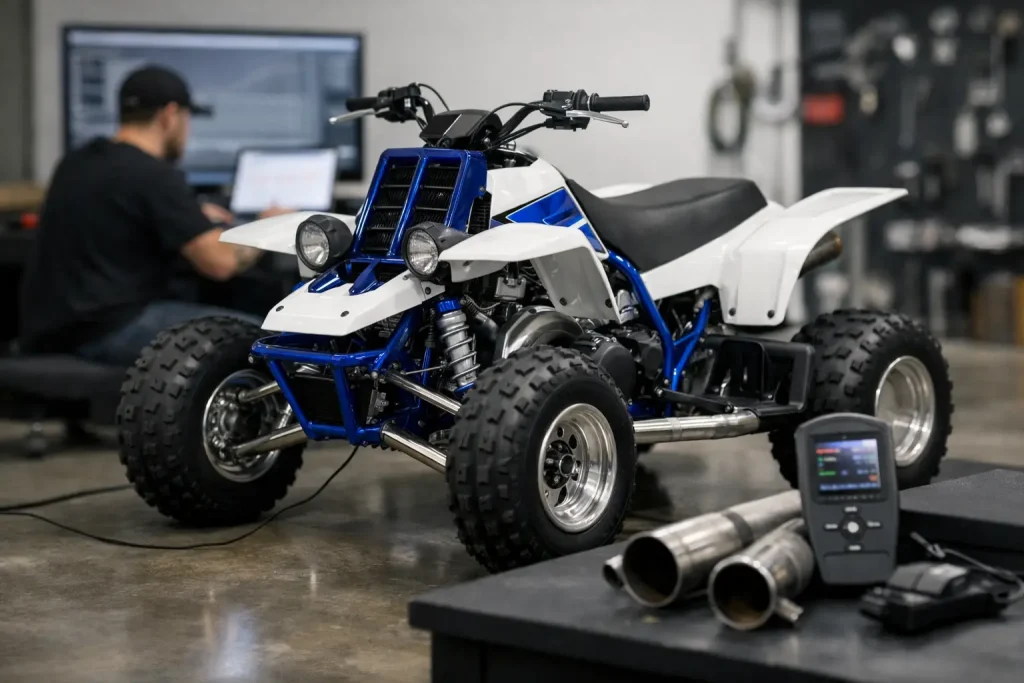
You can bolt on pipes, swap carbs, and spend real money on performance parts, but if the quad is not tuned correctly, a lot of that power stays on the table. So does tuning increase horsepower? On a Yamaha Banshee, absolutely – but only when tuning is done to match the engine, fuel, elevation, weather, and the parts actually on the machine.
That distinction matters. Riders often talk about tuning like it is a magic add-on. It is not. Tuning does not create horsepower out of nowhere in the same way bigger cylinders or aggressive port work can. What it does is let your engine use the horsepower your setup is already capable of making. In some cases, especially on a poorly running Banshee, the gain feels huge. In other cases, a well-sorted machine may only pick up a little on paper, but it will run cleaner, pull harder, and stay alive longer.
Does tuning increase horsepower or just improve throttle response?
For a Banshee, it can do both. A proper tune affects combustion efficiency, fuel delivery, ignition behavior, and how cleanly the engine moves through the rpm range. If the air-fuel ratio is off, timing is wrong, or the carbs are not synced well, the engine cannot make full power. Correcting those issues can add measurable horsepower, not just better feel.
The reason this comes up so often with Banshees is simple. These machines are extremely responsive to setup changes. Two-strokes do not hide mistakes very well. A slightly rich condition, a lean main, tired reeds, bad float height, or an ignition setup that does not match the build can turn a strong engine into one that feels lazy or inconsistent.
That is why one rider says a tune woke the quad up, while another says tuning did not add much. Both can be right. If your Banshee is already dialed, there may not be much left to gain. If it is close but not right, tuning can make the difference between average and seriously strong.
Where horsepower gains from tuning actually come from
On a Yamaha Banshee, tuning is not one adjustment. It is a group of adjustments working together. Carb jetting is usually the first place riders think about, and for good reason. If the pilot, needle, and main jet are not right for your intake, pipes, compression, and elevation, the engine will not pull the way it should.
A rich setup can make the quad feel soft, especially in the midrange. A lean setup may feel crisp for a moment, but it risks detonation, heat, and engine damage. The sweet spot is where the engine burns fuel efficiently and pulls cleanly under load. That is where horsepower shows up.
Ignition timing also plays a role. Some builds respond well to timing changes, while others become less reliable if timing gets too aggressive. More timing is not automatically more power. On pump gas, especially with higher compression, too much timing can hurt both performance and durability.
Then there is carb synchronization, idle quality, air leaks, reed condition, compression health, and exhaust fitment. Riders sometimes chase tuning when the real issue is mechanical. If the top end is tired or there is a leak at the intake boots, no amount of jet swapping will produce a clean, strong powerband.
Why mods and tuning have to match
A stock or near-stock Banshee has one tuning window. A modified Banshee has another. If you install performance pipes, VForce-style reeds, cool heads, bigger carbs, ported cylinders, or a stroker crank, the tune has to follow the build.
This is where people get disappointed. They add expensive parts expecting instant gains, then ride a machine that bogs, sputters, or falls flat on top. The problem is not always the part. Often, the part changed the engine’s airflow and fuel demand, but the tuning never caught up.
For example, pipes can absolutely transform a Banshee. But pipes that move the powerband higher in the rpm range may require different jetting, clutch setup, and even gearing if you want to feel the full benefit. Bigger carbs can support more airflow, but if they are oversized for the build or tuned poorly, low-end response can suffer.
The strongest Banshees are not just modified. They are matched. That means the engine combination, fuel, intake, exhaust, and tuning all support the same goal.
How much horsepower can tuning add?
There is no single number, and anyone giving one without seeing the machine is guessing. On a badly tuned Banshee, proper setup can make the quad feel like a different machine. On a mildly modified build, a clean tune may free up noticeable horsepower across the curve. On a race-oriented engine, fine tuning may only add a small peak number but sharpen the whole powerband.
That last part matters more than some riders realize. Peak horsepower gets attention, but usable horsepower wins rides. A Banshee that hits clean, pulls through the midrange, and revs out without laying down is more fun and often faster than one with a bigger claimed number and a messy tune.
If you are looking for realistic expectations, think in terms of optimization, not miracles. Tuning can absolutely increase horsepower, but it is usually best viewed as maximizing what your current combination can produce.
Does tuning increase horsepower on a stock Banshee?
Yes, it can, especially if the machine is old, neglected, or set up for different conditions than where you ride now. Many Banshees on the market have gone through years of owner changes, partial rebuilds, mystery parts, and guesswork jetting. Even a mostly stock quad can gain power from being brought back into proper spec.
That may mean cleaning and syncing carbs, correcting float height, replacing worn reeds, checking compression, setting timing properly, and dialing jetting for your pipes, filter setup, and fuel. A healthy stock-style Banshee with a proper tune usually starts easier, idles better, revs cleaner, and feels stronger everywhere.
For newer riders, that is often the smartest money spent. Chasing big parts before the base setup is right can lead to frustration fast.
The trade-off: more power can mean less margin for error
This is the part a lot of shops skip, but Banshee owners should hear it straight. As performance goes up, tuning becomes more critical. A mild trail setup has more forgiveness than a high-compression, aggressively ported engine spinning hard on the dunes.
That does not mean performance builds are a bad idea. It means the tune has to be treated like part of the build, not an afterthought. Weather changes, elevation changes, fuel quality, and riding style can all affect what the engine wants. A setup that runs clean in cool weather may not be safe on a hot day if it was already borderline lean.
For riders who want dependable horsepower, reliability should always be part of the tuning conversation. A Banshee that makes slightly less peak power but stays consistent and healthy is usually the better machine.
Signs your Banshee needs tuning
If the quad hesitates off idle, loads up in the midrange, fouls plugs, pings under load, runs unusually hot, or feels flat on top, the tune deserves attention. The same goes for any machine with fresh mods that has not been dialed in yet.
Another common sign is when the quad feels fast one day and off the next. Inconsistent behavior often points to tuning issues, fuel delivery problems, or air leaks. That is why experienced Banshee owners do not judge performance by one pull down the road. They look at the whole pattern.
When a machine is right, it feels crisp, predictable, and repeatable. That is not just good manners. That is horsepower you can actually use.
What smart tuning looks like
Smart tuning starts with the health of the engine. Compression, leak-down integrity, reeds, ignition, and carb condition all need to be known before chasing settings. After that, the tune should match the exact build and the way the quad is ridden.
For some riders, that means a safe, pump-gas dune setup with strong midrange. For others, it means a harder-hitting drag or play build where top-end pull matters more. There is no universal best tune. There is only the right tune for your Banshee.
That is why specialized platform knowledge matters. A general ATV shop may understand engines, but a Yamaha Banshee has its own habits, common mistakes, and proven combinations. At Banshee Retailer, that is the difference between guessing and actually setting a quad up to perform the way it should.
If you are asking whether tuning is worth it, the real answer is this: a Banshee without the right tune is a half-finished build. Get the setup right, and the machine will tell you immediately. It starts cleaner, pulls harder, and rewards every part you already paid for.
If your quad has power parts on it but still does not feel like it should, do not assume the answer is another box of parts. Sometimes the horsepower you are chasing is already there, waiting for the tune to catch up.