
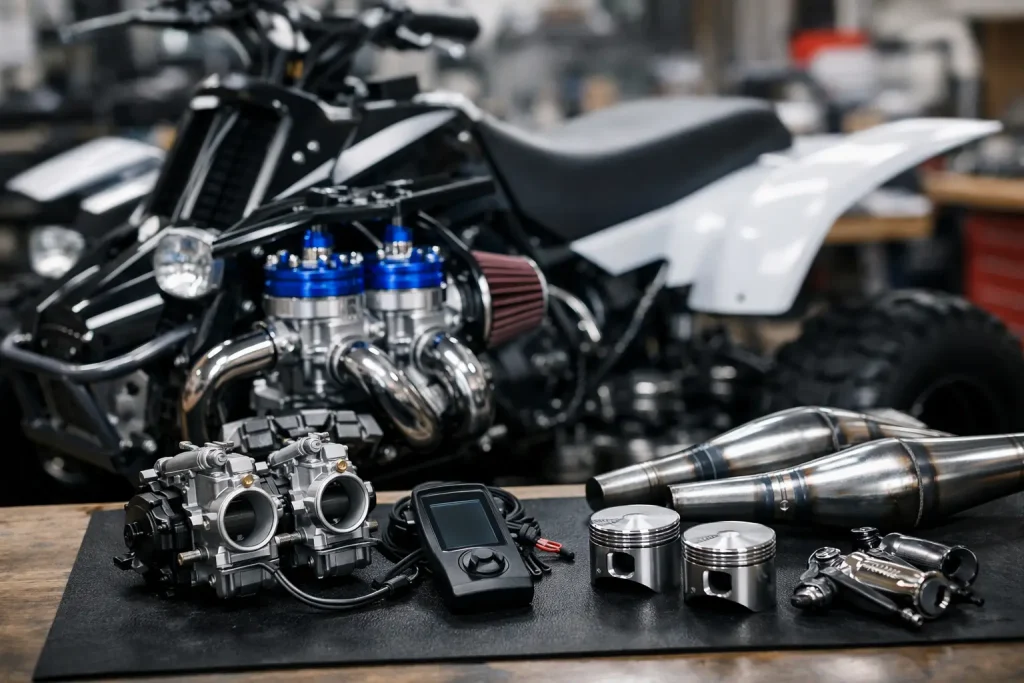
A Yamaha Banshee that hits hard through the midrange and keeps pulling on top does not happen by accident. High performance engine tuning is the difference between a quad that feels fast in the driveway and one that actually runs clean, repeatable power under load. On a Banshee, every change matters – pipes, porting, compression, timing, carb setup, gearing, and even how honest you are about where and how you ride.
That is why random bolt-ons so often disappoint. Riders install a pipe set, swap jets, maybe add a cool head, and expect the whole package to come alive. Sometimes it does. More often, the parts are fine but the combination is wrong. A dune setup behaves differently than a trail build. A drag motor wants different choices than a play bike. And a two-stroke Banshee will always punish lazy tuning faster than a lot of four-stroke platforms.
What high performance engine tuning really means
For a Yamaha Banshee, tuning is not just adding horsepower parts. It is building a combination where the engine’s airflow, fuel delivery, ignition timing, compression, and exhaust characteristics work together in the same rpm range. The goal is not simply peak power. The goal is useful power for your riding style, with enough reliability that the machine stays fun instead of becoming a teardown project every weekend.
That is where a lot of builds go sideways. Chasing the biggest dyno number sounds great until the quad becomes hard to start, fussy on pump gas, and flat everywhere except one narrow stretch of rpm. A strong Banshee setup should feel deliberate. It should pull where you need it, respond cleanly, and survive the conditions you actually ride in.
Start with the riding goal, not the parts list
Before buying anything, define the job the engine has to do. A woods rider usually needs crisp throttle response, manageable power, and a broad curve that does not force constant clutch work. A duner may want more aggressive top-end pull and enough over-rev to keep the paddles driving. A drag rider is building for a much narrower target, where low-end manners matter less than maximum acceleration over a short distance.
This matters because the same modification can be excellent in one build and wrong in another. Aggressive port timing may wake up a high-rpm dune or drag setup, but it can make a trail bike feel soft down low. Higher compression can improve snap and efficiency, but it also tightens the margin for error on fuel quality and heat control. Bigger carbs can support more airflow, yet oversized carbs on a mild engine often hurt response more than they help peak output.
If you want a fast, rideable Banshee, the smartest move is to choose a powerband first and then select parts that support it.
The parts that shape Banshee power
Pipes and exhaust character
On a two-stroke, pipes are not just exhaust parts. They are major tuning components. Expansion chambers heavily influence where the engine makes power, how hard it comes on, and how long it keeps pulling. That is why pipe choice should match the porting and intended use, not just the sound or brand name.
A pipe designed for broader power can make a mild or trail-focused engine feel alive everywhere. A more aggressive pipe can reward a ported engine with stronger top-end but feel lazy if the rest of the build cannot support it. Silencer length, stinger design, and overall pipe layout also affect response and ride feel. On a Banshee, the right pipe choice is often one of the biggest differences between a balanced setup and a frustrating one.
Porting and cylinder work
Porting is where engine personality really gets decided. Good cylinder work changes the timing and flow characteristics of the engine so the power comes in where you want it. This is not a place for guesswork. Clean, proven port work for a specific application matters far more than vague claims about being “race ported.”
A well-planned trail or dune port can transform a stock-based engine without making it temperamental. More extreme work can push peak numbers higher, but it narrows the window where the engine is happiest. There is always a trade-off. More rpm potential usually asks for better supporting parts, tighter tuning, and more attention to maintenance.
Compression and fuel
Compression is one of the quickest ways to change how a Banshee feels. More compression generally improves throttle response and can add torque, but only if your fuel supports it. This is where riders get into trouble. Tightening up the head for a stronger hit and then feeding the engine weak pump gas is a classic recipe for detonation.
Squish clearance, dome design, altitude, temperature, and riding load all matter. A setup that survives short blasts in cool weather may not stay happy during long dune pulls in summer heat. Smart tuning keeps a safety margin. Peak pressure is exciting right up until it starts damaging pistons.
Carbs and jetting
A Banshee will tell you when the carb setup is wrong. It may hesitate, load up, feel flat, run hot, or leave power on the table. Carb size should fit the engine combination. Bigger is not automatically better. A moderate carb that keeps velocity high often delivers better real-world performance on a play or trail machine than a larger carb that only shines at full song.
Jetting is where high performance engine tuning becomes real. Main jet, pilot jet, needle position, slide cutaway, air screw setting, and synchronization all affect how the machine runs. Weather changes matter too. Temperature, humidity, and elevation can shift what the engine wants. There is no shame in revisiting jetting. On a two-stroke performance build, that is part of owning the machine properly.
Ignition timing and the fine line between sharp and risky
Timing changes can wake up an engine or hurt it fast. Advancing timing may sharpen response and help certain setups, but too much can increase heat and detonation risk. Retarding timing in the right application can improve safety at higher rpm or with more aggressive cylinder pressure, but it may soften response if overdone.
This is why timing should never be treated like a universal trick. It has to match the rest of the build. Compression, fuel octane, pipe design, port timing, and intended rpm all influence what the engine will tolerate. Good tuning looks at timing as part of the system, not a magic standalone fix.
Reliability is part of performance
The fastest Banshee in theory is useless if it spends more time apart than on the ground. Real performance includes durability. Crank health, bearing quality, seal condition, cooling efficiency, and assembly precision all matter just as much as the flashy parts.
Air leaks are especially dangerous on a two-stroke. A lean condition caused by bad seals or intake leaks can turn an expensive build into scrap quickly. Cooling system health is another big one. More power creates more heat, and a neglected cooling setup can erase the gains from your engine work. Clutch condition also matters more than many riders admit. If the clutch is slipping or inconsistent, the engine cannot deliver power cleanly.
For most riders, the strongest setup is not the one with the most extreme spec sheet. It is the one that starts, runs clean, stays together, and puts power down ride after ride.
Why tuning a Banshee is different from tuning generic two-strokes
The Banshee platform rewards specialization. These engines have their own habits, common weak points, and proven combinations. That is why category expertise matters. Generic performance advice can miss the details that separate a sharp build from an expensive mistake.
A Yamaha Banshee responds best when the builder understands the full package – stock stroke versus cub, play riding versus dunes, pump gas versus race fuel, stock cylinders versus aftermarket options, and how those choices affect everything from jetting to clutch setup. This is exactly why dedicated Banshee shops and parts sources are valuable. You are not buying random speed parts. You are building a combination.
At Banshee Retailer, that focused approach is the point. Riders want more than inventory. They want parts, service, and tuning choices that make sense together.
The smartest way to approach high performance engine tuning
The best builds usually happen in stages. Start with a healthy baseline. Compression test it, inspect for leaks, confirm the crank and top end are sound, and make sure the cooling and fuel systems are right. Then choose a realistic power goal. From there, build around a matched combination of pipes, cylinder work, compression, carbs, and ignition strategy.
Do not tune by ego. Tune by use case. If your Banshee spends most of its life on trails, build for response and spread. If you live for wide-open sand, build for sustained pull and rpm. If you are chasing short-course acceleration, accept that the setup may become more specialized and less forgiving.
The best part of the platform is that a well-tuned Banshee does not need to be outrageous to feel special. When the combination is right, the quad starts easier, runs cleaner, pulls harder, and gives you that unmistakable two-stroke hit without feeling like a hand grenade with tires.
Build it with a plan, tune it with patience, and let the machine tell you what it wants.